Choosing a China Top Black Felt Storage Basket Supplier requires more than comparing catalog prices. The right partner should combine consistent felt quality, accurate dimensions, reinforced stitching, and dependable production control. A basket may look attractive online, yet its handles can loosen after repeated lifting. Its shape may also collapse under heavier blankets or children’s toys.
Professional organizer Peter Walsh says, “Clutter is not just physical stuff; it’s old ideas, toxic relationships, and bad habits.” His observation explains why storage products must support real routines, not merely decorate a room. A well-made Black Felt Storage Basket should slide smoothly beneath a shelf, stand firmly beside a sofa, and protect folded clothing from rough edges. Small details matter.
This guide examines how to identify reliable Chinese manufacturers and compare their capabilities. It considers felt density, odor control, seam finishing, handle strength, color consistency, and packaging protection. Custom logos and private-label services also deserve careful review. Ask for current samples. Request factory photographs, inspection records, and clear material specifications. Do not trust polished product pages alone.
There is no universal “top” supplier.
The best choice depends on your market, order volume, target price, and quality expectations. A low-cost basket may suit promotional orders, but it may disappoint premium homeware buyers. I have seen specifications look complete while missing load testing and shrinkage details. That gap deserves attention. Practical verification, transparent communication, and repeatable samples provide stronger evidence than impressive claims. This approach helps buyers build a dependable Black Felt Storage Basket program with fewer surprises.
What Is a Black Felt Storage Basket?
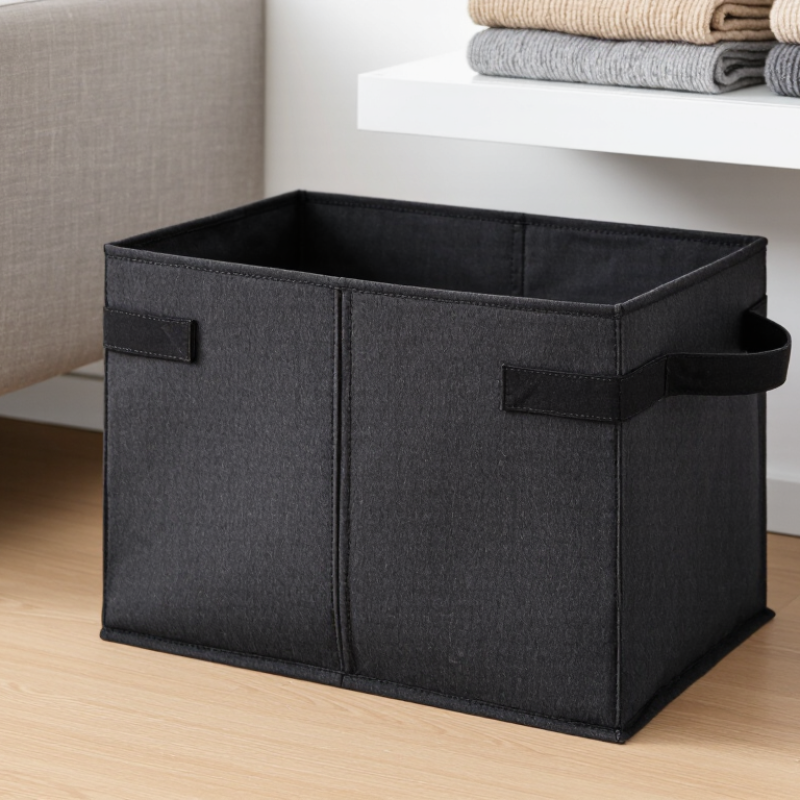
A black felt storage basket is a soft-sided container made from compressed textile fibers. It holds clothing, toys, books, blankets, and everyday clutter. The black color hides small marks, while felt creates a warm, quiet appearance. Unlike rigid plastic bins, it can flex inside narrow shelving. Many baskets include stitched handles for lifting from closets or cube units. Some have reinforced rims, but not all do. That detail matters.
From a supplier’s perspective, quality begins with fiber density, seam accuracy, and shape recovery. Dense felt should feel firm, not papery, and the basket should stand after light handling. Check the base, because thin bottoms may sag under towels or shoes. A practical sample test is simple: fill it halfway, lift both handles, and inspect the stitching. It should not pull apart or twist. Felt also collects dust and may show lint against black surfaces, so gentle vacuuming works better than aggressive washing. Care instructions need checking; soaking can permanently weaken the shape. That is an easy mistake. For homes, offices, and retail displays, a well-made black felt basket offers quiet storage and visual order. Its usefulness depends less on color than on construction and intended load.
How Are Black Felt Storage Baskets Designed and Made in China?
Black felt storage baskets in China usually begin with a practical material choice: polyester felt, often made from recycled PET fibers. Textile Exchange’s Materials Market Report 2024 estimated recycled polyester at about 14% of global polyester production in 2023. That figure covers all products, not baskets alone. Still, it explains why recycled felt appears frequently in export specifications.
The design process starts with usage requirements. Engineers measure basket width, depth, handle stress, and folding points. CAD drawings then guide die-cutting, stitching, or ultrasonic bonding. A typical basket may use 2–5 millimeter felt, reinforced handles, and a folded rim for stiffness. Black dyeing must remain even under strong warehouse lighting. It sounds simple. It is not.
Factories usually inspect felt weight, cutting accuracy, seam strength, odor, and dimensional recovery after folding. Some buyers request colorfastness or abrasion testing under ISO-based procedures. Sampling remains essential because recycled fibers can create slight texture changes between production lots. This is one weakness I would not hide. A basket can look excellent in photographs yet lose shape after repeated loading. Better suppliers test finished pieces, not only raw felt, and record results for every batch.
What Makes a Top Chinese Felt Basket Supplier?
A top Chinese felt basket supplier offers more than a low quotation. The real test is consistent quality, clear communication, and practical production experience. Experienced suppliers understand how felt density affects shape, strength, and appearance. Ask for the material composition, thickness, weight, and available colors. A reliable factory should provide these details without hesitation.
Inspect a physical sample carefully. Check the stitching around handles, the firmness of the bottom, and the edges after repeated folding. The basket should stand evenly on a shelf. It should not release a strong chemical odor. Ask for colorfastness, material safety, and quality inspection records when suitable. A professional supplier can explain testing methods and production limits. Still, certificates alone are not enough. A perfect sample may hide weak bulk production.
Tips:
Request a pre-production sample and a packing sample. Confirm dimensions in writing. Ask how defects are recorded and corrected. Keep one approved sample for comparison. Small details matter.
Production control also reveals supplier reliability. Look for incoming material checks, sewing inspections, and final quantity verification. Clear lead times are important, but honest updates matter more when delays occur. Some suppliers promise too much to win an order. That can become expensive later. I would rather choose a factory that admits a limitation and proposes a workable adjustment. Even experienced buyers can overlook packaging pressure or slight size changes after folding. Careful communication prevents those surprises.
How to Evaluate Quality, Customization, and Production Capacity
China Top Black Felt Storage Basket Supplier?
How to Evaluate Quality, Customization, and Production Capacity
A reliable supplier should prove quality beyond attractive product photos. Check felt density, thickness, odor, color consistency, and edge stitching. A practical sample should hold books without collapsing. Test the handles with repeated lifting. Inspect the inner seams, especially around corners. ISO 2859-1 sampling methods can support structured inspections, but they cannot replace judgment. A perfect sample can still hide a weak process.
Customization needs more than adding a logo. Confirm the exact dimensions, felt weight, color reference, label position, packaging, and acceptable tolerances. Ask for a pre-production sample before mass manufacturing. For recycled felt, request evidence of material content and traceability. Textile Exchange’s 2024 Materials Market Report recorded 124 million tonnes of global fiber production in 2023. That scale makes vague sustainability claims worth questioning.
Tips: Request three samples from different production batches. Compare color, stiffness, stitching, and smell. Ask for the supplier’s inspection checklist and defect limits. Minor differences may be normal; unexplained differences are not.
Production capacity should be measured, not promised. Review monthly output, active orders, equipment, workforce, and peak-season lead times. A factory may quote 50,000 baskets monthly but lack enough cutting or stitching stations. Request recent production records, a capacity plan, and a realistic delivery schedule. Include a small pilot order. It may slow the launch, yet it reveals bottlenecks earlier. Supplier evaluation is never perfectly clean. Good decisions leave an audit trail.
How to Select the Right China-Based Supplier for Your Business
China Top Black Felt Storage Basket Supplier?
How to Select the Right China-Based Supplier for Your Business
Selecting a China-based supplier requires more than comparing the lowest quotation. Request a detailed specification for felt thickness, basket dimensions, handle strength, stitching, color consistency, and packaging. Ask whether the material is virgin or recycled felt. Both can work, but they suit different price points and durability expectations.
Request physical samples before placing a production order. Check the basket on a flat table. Does it keep its shape? Pull the handles firmly. Inspect loose threads, uneven edges, odor, and surface pilling. A supplier should explain its quality-control process and provide clear tolerance limits. Factory photographs are useful, but a live video inspection or independent audit offers stronger evidence. Do not rely on polished images alone.
Small details matter. Confirm minimum order quantities, sample fees, production timing, carton measurements, and replacement procedures in writing. Ask for a pre-shipment inspection before final payment. A low price may hide thinner felt, weaker seams, or poor cartons. I would also test one packed unit through a local courier. It can reveal crushing that factory checks miss. Communication deserves attention too. Slow, vague replies often create expensive misunderstandings. No supplier is perfect. A responsible partner acknowledges defects, records corrective actions, and improves the next batch.
Conclusion
A Black Felt Storage Basket is a practical and attractive organization solution made from durable felt fabric. Its soft structure helps protect stored items, while its neutral black color fits naturally into homes, offices, hotels, and retail environments. Chinese manufacturers typically design these baskets with reinforced walls, stable bases, convenient handles, and optional folding features. Production may include material selection, cutting, stitching, edge finishing, shaping, and final quality inspection to create a reliable product with a clean appearance.
A top Chinese felt basket supplier should offer consistent quality, flexible customization, clear communication, and dependable production capacity. Buyers should evaluate felt thickness, stitching strength, dimensional accuracy, load performance, color consistency, packaging, and sample quality before placing an order. It is also important to confirm minimum order quantities, customization options, lead times, inspection procedures, and after-sales support. By comparing suppliers carefully and matching their capabilities with business requirements, buyers can select a suitable China-based partner for long-term cooperation.

 Ulike Felt