Choosing the right Felt Storage Containers is rarely as simple as comparing colors and prices. Global buyers must examine material density, stitching quality, handle strength, odor, dimensions, and packaging. A soft gray basket may look attractive, yet collapse under books or toys. That detail matters.
Felt artist and textile designer Anne Kyyro Quinn is often associated with this practical view: “Felt should serve the object, not merely decorate it.” This principle helps buyers assess real performance. Wool felt offers warmth, resilience, and a refined texture. Polyester felt can provide consistent thickness and easier cost control. Recycled fibers may support sustainability goals, but their quality varies between suppliers.
This guide introduces ten useful types of Felt Storage Containers for homes, offices, hotels, nurseries, and retail spaces. Options include cube bins, folding baskets, drawer organizers, toy bags, document boxes, magazine holders, and hanging pockets. Each type suits a different storage problem. Some prioritize portability. Others protect shelves from scratches.
Look closely at the seams.
Request samples before large orders. Measure the inner capacity, not only the outer size. Ask suppliers about fiber content, colorfastness, load testing, production tolerance, and inspection procedures. Certifications can support trust, but they should be verified through current documentation. A supplier’s product photos are not enough.
There is room for honest doubt. “Eco-friendly” labels may hide mixed materials or weak durability. A lower price may create higher replacement costs later. The best container is not always the thickest one. It is the one that fits its intended load, survives repeated handling, and remains practical after the first month.
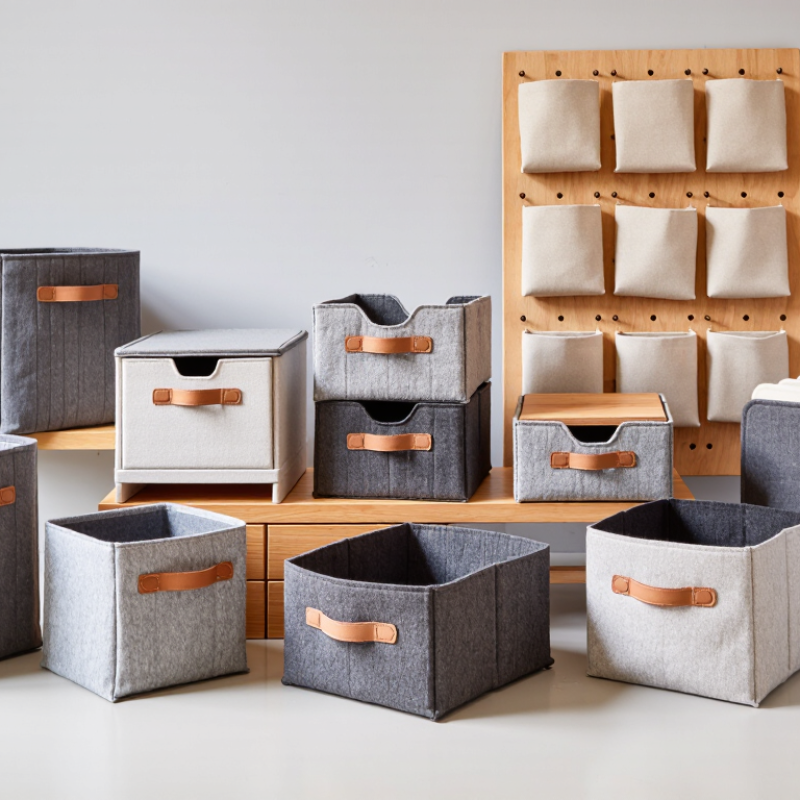
Felt storage containers combine recycled polyester, wool, or blended fibers with practical structure. Grand View Research valued the global nonwoven fabrics market at approximately USD 53.7 billion in 2023. It also forecasts strong growth through 2030. This supports wider use of felt in home organization, retail packaging, offices, hotels, and nurseries.
Popular formats include cube bins, drawer organizers, closet boxes, basket-style bins, shelf baskets, toy bags, laundry hampers, document holders, cable boxes, and collapsible travel cases. Recycled polyester felt offers consistent color, low weight, and moisture resistance. Wool felt provides a softer hand and better thermal performance, but usually costs more.
Buyers should check fiber thickness, stitching density, handle strength, edge binding, and fold recovery. These details affect container life more than appearance alone. I have found that thin felt can look attractive but sag under books. That weakness is easy to miss.
Tips: Request samples before bulk purchasing. Test stacking, odor, seam pressure, and cleaning response. The Global Recycled Standard can help verify recycled content claims, while ISO 3758 supports textile care-label communication. For export projects, specify carton dimensions, nesting ratios, and measured product weight. Small measurement errors increase freight costs quickly. Color matching also deserves caution, because recycled fibers may create slight shade variation. That is not always a defect, but buyers should define acceptable tolerance early.
Foldable felt bins suit homes and offices that need storage without permanent bulk. Their soft walls protect books, cables, toys, and clothing from sharp edges. When empty, most collapsible designs fold nearly flat inside a wardrobe or shipping carton. That detail matters for international buyers facing storage and freight pressure. The World Bank reports that packaging accounts for about 40% of global plastic use, so reusable felt packaging can support lower material demand when designed for repeated use. Still, felt is not automatically sustainable. Buyers should verify recycled content, dye safety, stitching strength, and end-of-life options.
In practical testing, a useful bin should keep its shape under moderate weight. Reinforced handles should survive repeated lifting, not only a showroom demonstration. A 30-centimeter cube can hold notebooks, chargers, or folded towels, while larger rectangular bins fit beneath desks and beds. The U.S. Environmental Protection Agency reported 17.03 million tons of textile waste in municipal solid waste streams in 2018, with only 2.51 million tons recycled. This makes material durability important. A thin bin may look attractive but fail quickly. I would not promise complete organization, either; inconsistent labeling and overfilling still create clutter. Buyers should request sample inspections, compression tests, dimensional tolerances, and packaging details before placing bulk orders.
Top 10 Types of Felt Storage Containers for Global Buyers
Felt Storage Baskets for Shelves, Closets, and Everyday Essentials
Felt storage baskets turn open shelves, closets, and bedside areas into calmer spaces. Popular types include cube bins, lidded boxes, drawer organizers, hanging baskets, and foldable totes. Slim shelf baskets suit books, scarves, and small towels. Deep closet bins hold sweaters, toys, or spare linens without looking bulky. Handles make lifting easier, especially when baskets sit above eye level. I have found that reinforced handles matter more than decorative stitching during regular use.
Buyers should compare basket dimensions with shelf depth, not only the advertised capacity. A basket that fits tightly may scrape furniture or become difficult to remove. Look for firm felt, even seams, stable bases, and clear care instructions. Some containers fold flat for shipping, but creases may remain after unpacking. That is not always a defect. Still, it deserves checking. Neutral colors support shared interiors, while labeled compartments improve daily retrieval.
Tips: Measure the shelf opening first. Leave a small gap for easy handling. Use smaller baskets for cables, cosmetics, and children’s accessories. Avoid overloading soft-sided containers, because their walls can bend and handles may strain. For closets, group items by frequency of use. Everyday essentials should stay within comfortable reach. Before larger orders, test one sample for odor, stitching, load stability, and color consistency. Felt can collect dust, so gentle vacuuming is usually safer than soaking. A washable design sounds useful, but care labels must be followed carefully.
Felt storage baskets for shelves, closets, and everyday essentials, compared by representative external width in centimeters.
These representative dimensions reflect common retail size conventions for household felt organizers. Actual product sizes may vary according to construction, intended storage space, and customer requirements.
Felt boxes and cubes are practical core units for modular storage systems.
Their soft walls protect shelves, toys, clothing, and office supplies from scratches. Cubes fit common grid shelving, while rectangular boxes use deeper compartments more efficiently. Before ordering, global buyers should check external and internal dimensions. A few millimeters can affect the entire layout. I have found that reinforced handles make frequent movement easier, especially in classrooms and shared offices. However, felt is not automatically rigid. Poorly supported sides may bend after repeated use.
Tips: Request a sample before bulk purchasing. Test the cube with its intended load. Check stitching, edge binding, odor, color consistency, and handle strength. Ask for material composition and care instructions. Compare folded shipping dimensions with storage volume. This prevents attractive samples from creating expensive surprises.
Modular felt containers work best when sizes follow a clear system. Use smaller cubes for cables, stationery, and accessories. Reserve larger boxes for blankets, files, or seasonal items. Add simple labels on the front panel for faster identification. Ventilation also matters for textiles stored in enclosed spaces. Keep containers dry and avoid placing heavy items on soft lids. My own preference has changed: deeper boxes look efficient, but shallow cubes often keep contents more visible. That trade-off deserves testing.
Top 10 Types of Felt Storage Containers for Global Buyers
Global buyers usually compare felt containers by size before appearance. Measure shelves, drawers, and shipping cartons carefully. A container that fits one market may waste space in another. The ten common formats include cube bins, open baskets, lidded boxes, drawer organizers, under-bed bags, hanging shelves, storage trays, toy bins, laundry hampers, and cable pouches. Small trays suit accessories, while deep bins hold blankets or seasonal clothing. Cubes work well in modular furniture. Under-bed bags need flexible sides and reliable handles.
Design should match the user’s habits, not only current trends. Lids protect contents from dust, but they reduce access speed. Handles improve carrying, although weak stitching can fail under heavy loads. Buyers should inspect edge binding, seam density, felt thickness, and base reinforcement. Recycled fibers may support sustainability goals, but their texture and strength can vary. Durability also depends on moisture exposure, folding pressure, and repeated loading. A compact container lowers freight volume, yet excessive compression may create permanent creases. That trade-off deserves testing.
Market needs differ across homes, offices, hotels, and retail projects. Neutral colors often support wider sales, while regional color preferences still matter. Child-focused designs need smooth edges and stable bases. Office organizers should resist daily handling and keep their shape. Laundry containers require stronger construction than light display baskets. In sample checks, attractive products sometimes felt less practical. Buyers should test a filled unit, not an empty one. No container is perfect.
| Felt Container Type | Typical Size Range | Recommended Load | Common Design Features | Durability Profile | Best-Fit Market Needs | Space Efficiency | Typical Contents |
|---|---|---|---|---|---|---|---|
| 1 Felt Storage Basket | Small to large 20–45 cm wide 15–35 cm high |
Light to medium approximately 3–8 kg |
Open top Reinforced rim Handles optional | Good for indoor daily use; stitched or bonded handles improve service life. | Home organization, nursery storage, retail displays, and hotel rooms. | Stackable when reinforced; flexible walls allow partial nesting. | Blankets, toys, towels, books, and household accessories. |
| 2 Felt Storage Box with Lid | 30–60 cm long 20–40 cm wide 15–35 cm high |
Medium approximately 5–12 kg |
Foldable body Attached or removable lid Label window | Very good for dust protection; rigid inserts help maintain shape during repeated handling. | Closets, shelving systems, moving storage, and seasonal goods. | Designed for vertical shelving; collapses flat when empty. | Clothing, documents, bedding, toys, and seasonal decorations. |
| 3 Felt Cube Organizer Bin | Common cube format 28–35 cm per side |
Light to medium approximately 3–7 kg |
Cube-compatible Front pull handle Foldable panels | Good for frequent pull-out use; base reinforcement reduces sagging. | Modular furniture, apartments, dormitories, and office shelving. | Excellent use of cubby space; units can be arranged in grids. | Clothes, accessories, children's items, cables, and office supplies. |
| 4 Felt Drawer Organizer | 15–35 cm long 10–25 cm wide 5–15 cm high |
Light approximately 1–4 kg |
Divided compartments Low profile Non-slip base | Suitable for light items; dense felt helps protect surfaces from scratches. | Kitchen drawers, office desks, vanities, and workshop storage. | High efficiency in shallow or irregular drawers. | Cutlery, stationery, cosmetics, watches, tools, and small electronics. |
| 5 Felt Hanging Organizer | 25–45 cm wide 50–120 cm high |
Light to medium approximately 2–6 kg total |
Vertical pockets Hook or loop fastening Multiple tiers | Good when seams and hanging points are reinforced; avoid overloading upper pockets. | Small homes, wardrobes, travel rooms, and retail merchandising. | Uses vertical space and leaves floor and shelf areas free. | Shoes, scarves, accessories, baby items, cables, and craft supplies. |
| 6 Felt Under-Bed Storage Bag | 60–100 cm long 35–60 cm wide 15–25 cm high |
Medium approximately 5–15 kg |
Low profile Zipper or flap closure Pull handles | Good for occasional access; a reinforced base is important for sliding and lifting. | Seasonal storage, compact homes, student housing, and guest rooms. | Uses otherwise unused space beneath beds and sofas. | Quilts, shoes, winter clothing, linens, and luggage accessories. |
| 7 Felt File and Document Box | 30–40 cm long 24–32 cm wide 10–20 cm high |
Medium approximately 4–10 kg |
Rectangular structure Label slot Handle cut-outs | Very good for dry indoor environments; rigid sides protect papers from bending. | Home offices, schools, archives, studios, and administrative storage. | Efficient on standard shelves and in filing cabinets. | Folders, receipts, notebooks, magazines, and stationery. |
| 8 Felt Toy Storage Bag | 35–60 cm diameter 35–55 cm high |
Medium approximately 4–10 kg |
Wide opening Rope or fabric handles Decorative panels | Good for family use; reinforced handles and double stitching support frequent movement. | Children's rooms, playrooms, daycare centers, and gift markets. | Flexible shape accommodates irregularly sized items. | Soft toys, building blocks, balls, costumes, and games. |
| 9 Felt Cable and Electronics Case | 20–35 cm long 12–25 cm wide 5–12 cm high |
Light approximately 1–3 kg |
Zipper closure Elastic loops Protective padding | Good for abrasion protection; water resistance depends on the felt treatment and lining. | Travel, remote work, business gifts, electronics retail, and commuting. | Compact and easy to place inside luggage or backpacks. | Chargers, adapters, power banks, headphones, and computer accessories. |
| 10 Felt Wine and Bottle Carrier | 2–6 bottle capacity 26–38 cm high |
Medium to heavy approximately 5–15 kg |
Individual dividers Reinforced handles Protective padding | Very good when designed with a firm base and securely stitched carrying handles. | Gifting, hospitality, grocery delivery, events, and reusable packaging. | Separates bottles while remaining lightweight and foldable. | Wine, spirits, olive oil, beverages, and gift bottles. |
Note: Dimensions and load capacities are typical commercial ranges for general indoor use. Actual performance depends on felt density, recycled-fiber content, thickness, reinforcement method, stitching quality, moisture exposure, and product construction.
Common materials include recycled polyester, wool, and blended fibers. Recycled polyester is lightweight and moisture-resistant. Wool feels softer and offers better thermal performance, but usually costs more.
Popular formats include cube bins, drawer organizers, closet boxes, shelf baskets, toy bags, and laundry hampers. Document holders, cable boxes, and travel cases are also common.
Check felt thickness, stitching density, handle strength, edge binding, and fold recovery. Test the container with its intended load. Samples reveal weaknesses.
Yes, many fold nearly flat when empty. This reduces carton volume and storage pressure. Buyers should confirm folded dimensions, nesting ratios, and actual product weight.
Place books, towels, or office supplies inside the sample. Lift it repeatedly by the handles. Check sagging, seam pressure, odor, and shape recovery after folding.
A 30-centimeter cube can hold notebooks, chargers, or folded towels. Larger rectangular bins fit beneath desks and beds. Smaller cubes suit cables and stationery.
No. Sustainability depends on recycled content, durability, safe dyes, repeated use, and end-of-life options. A thin container may fail quickly, creating more waste.
Small errors in carton dimensions and product weight can increase shipping costs. Confirm measurements before production. Measure twice.
Recycled fibers may create slight shade variation between batches. Define acceptable color tolerance before ordering. A small variation is not always a defect.
Avoid overfilling, placing heavy items on soft lids, and storing felt in damp areas. Add simple front labels for faster identification. Organization is not guaranteed.
Felt Storage Containers offer a practical and stylish way to organize homes, offices, bedrooms, closets, and retail spaces. Made from soft yet durable felt, they help protect stored items while reducing visual clutter and surface scratches. Common options include foldable bins, storage baskets, felt boxes, cubes, drawer organizers, hanging containers, and compartmented designs. Their lightweight construction makes them easy to move, while foldable styles can be stored flat when not in use.
Different container types support different organization needs. Felt baskets are useful for shelves, closets, and everyday essentials, while boxes and cubes work well with modular storage systems. When selecting products for global markets, buyers should consider size, shape, color, handle design, folding performance, stitching quality, load capacity, and ease of cleaning. Market preferences may also vary according to room style, climate, packaging requirements, and consumer lifestyles. By balancing appearance, durability, functionality, and space efficiency, buyers can choose felt storage solutions suitable for flexible home and office organization.

Ulike Felt