Why Choose Small Felt Baskets for Global Wholesale?

Time:2026-10-07 Author:Isabella
0%

Global wholesale buyers are rethinking everyday storage. The global home décor market reached an estimated USD 682.1 billion in 2023, according to Fortune Business Insights. Its continued growth reflects demand for practical, attractive household products. A Small Felt Basket fits this shift with soft texture, useful capacity, and compact shipping dimensions.

Felt baskets support several retail channels. They suit nurseries, bedrooms, offices, hotels, and gift shops. Their foldable construction can reduce warehouse volume and improve container efficiency. Nested units also simplify counting, palletizing, and replenishment. Retailers can offer neutral grey, natural beige, or custom colors. These options support private-label programs without changing the basic product structure.

Material choices require careful judgment. Textile Exchange reported that recycled polyester reached 12% of global fiber production in 2023. Recycled PET felt may support a clearer material story. However, recycled content does not automatically make a product sustainable. That caveat matters. Buyers should request fiber composition, colorfastness, odor, load-bearing, and seam-strength documentation. They should also confirm packaging materials and factory quality procedures.

Wholesale success depends on more than appearance. Consistent dimensions protect shelf presentation. Reinforced handles reduce damage during customer use. Low minimum order quantities may help test new markets. Yet very low prices can hide weak stitching or unstable felt density. Experienced buyers compare samples, production batches, lead times, and replacement policies. The UN Environment Programme has emphasized resource efficiency and longer product use in its circularity work. A durable Small Felt Basket can support that direction, provided suppliers verify their claims. It is not perfect. But its blend of function, customization, and manageable logistics makes it a practical global wholesale option.
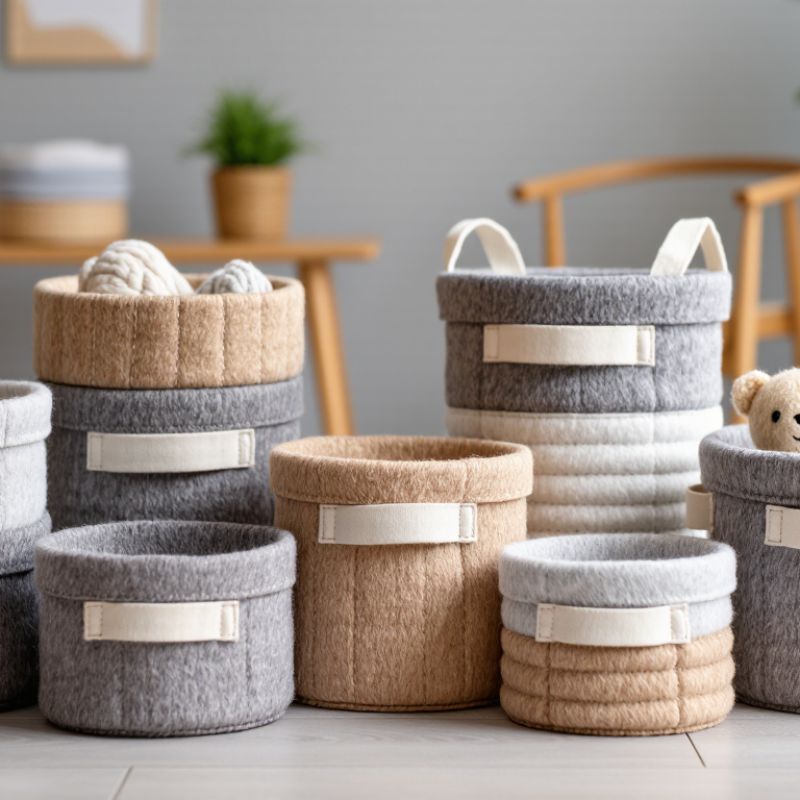
Why Choose Small Felt Baskets for Global Wholesale?

What Are Small Felt Baskets and How Are They Made?

Small felt baskets are compact fabric containers used for organizing shelves, desks, bathrooms, and children’s rooms. They are usually made from wool felt, synthetic felt, or recycled polyester fibers. Their soft walls protect nearby surfaces and reduce noise when items are placed inside. Small sizes also make packing and shipping easier for wholesale buyers.

Manufacturing begins with cleaning, blending, and pressing fibers into dense sheets. Needle punching then locks the fibers together through repeated mechanical needling. Some producers use heat, moisture, or adhesive treatments to improve strength and shape retention. The finished felt is measured and cut into panels, often with computer-controlled blades. Workers stitch the panels, reinforce handles, and check the base for stability. Simple designs may use folded seams, while heavier baskets need extra binding around the rim.

From practical sourcing experience, thickness matters more than appearance alone. Thin felt may look neat but collapse under heavier contents. Dense felt usually keeps its form better, although it can increase production costs. Color consistency also requires careful batch control. Small differences can appear between production runs. That is easy to overlook. I would not describe every felt basket as automatically sustainable, either. Recycled fibers can reduce material waste, but transport, dyes, adhesives, and packaging still affect the product’s footprint. Wholesale buyers should request fiber details, dimensions, load testing, and sample approval before placing large orders.

Why Small Felt Baskets Suit Global Wholesale Markets

Small felt baskets suit global wholesale markets because they balance practical design, manageable shipping, and broad customer appeal. In my sourcing experience, buyers often prefer products that are light, stackable, and easy to display. A small basket can hold cables, cosmetics, stationery, or nursery accessories. Its compact size also helps reduce carton space and freight pressure.

Felt offers a soft surface with useful structure. It protects shelves and furniture from minor scratches. Consistent stitching, firm handles, and accurate measurements matter during wholesale inspections. Buyers should request material details, size charts, color samples, and packaging specifications before placing large orders. Small differences can affect customer reviews. My cost estimates are never perfect, especially when freight rates change between regions.

Tips: Compare folded and assembled dimensions before confirming cartons. Ask for clear photos of seams and handles. Choose neutral colors for wider markets, then test brighter shades in smaller quantities. Check whether the packaging protects the baskets from moisture during long transit. A simple inspection checklist can prevent avoidable quality disputes. Consistent labeling also supports smoother warehouse handling across countries.

Why Choose Small Felt Baskets for Global Wholesale? - Why Small Felt Baskets Suit Global Wholesale Markets
Wholesale Dimension Typical Small Felt Basket Data Why It Suits Global Wholesale Markets Practical Purchasing Consideration
Common Product Size Approximately 15–30 cm in length, 10–25 cm in width, and 8–20 cm in height Compact dimensions fit common retail shelves, bathroom storage areas, desks, nurseries, and gift sets Confirm finished dimensions after assembly because stitching, folding, and reinforcement can affect usable capacity
Material Options Wool felt, polyester felt, or recycled polyester felt are commonly used material categories Different material options allow buyers to balance appearance, softness, price, durability, and sustainability requirements Request the fiber composition, material thickness, weight per square metre, and test documentation before ordering
Typical Material Thickness Approximately 2–5 mm for many small storage-basket constructions Provides a balance between shape retention, foldability, handle strength, and material consumption Thicker felt may improve structure but can increase product weight, packing volume, and freight cost
Weight and Freight Efficiency Many small felt baskets weigh roughly 80–350 g per piece, depending on size, thickness, lining, and hardware Relatively low unit weight can support economical carton planning and easier handling throughout international distribution Use the finished packed weight rather than material weight when calculating landed cost
Nesting and Flat Packing Soft-sided or foldable designs can often be nested or shipped partially folded Reduced empty space can improve carton utilization and help lower storage and transportation volume Check whether folding creates permanent creases and whether the basket needs inserts or reshaping before retail display
Customization Potential Common options include color, size, handle shape, label placement, embroidery, printing, and compartment design A simple base construction can be adapted for different countries, sales channels, seasons, and end uses Approve a pre-production sample to verify color, logo position, dimensions, stitching, and handle load strength
Color Range Felt is available in neutral, pastel, bright, and custom-dyed color groups Broad color selection supports home organization, children’s products, seasonal collections, and coordinated gift packaging Ask for laboratory or supplier color references because screen colors and batch colors can differ
Shape Stability Shape retention depends on felt thickness, density, edge binding, stitching, inserts, and handle reinforcement Small baskets can provide practical organization while remaining softer and lighter than many rigid containers Test the empty and loaded basket for standing stability, seam strength, and deformation after repeated handling
Care and Maintenance Most felt baskets are intended for gentle spot cleaning, vacuuming, or light hand cleaning rather than aggressive machine washing Simple care instructions make the product suitable for household, office, nursery, and hospitality applications Include care guidance appropriate to the actual fiber composition, dyes, lining, and construction
Safety and Chemical Testing Testing may cover restricted substances, colorfastness, flammability, mechanical strength, and applicable product-safety requirements Documented testing helps importers evaluate compliance across different destination markets Requirements vary by destination and intended use; children’s products require additional safety review compared with general storage products
Retail and E-Commerce Suitability Small baskets are easy to display, photograph, bundle, and ship in protective outer packaging Compact organization products can serve physical retail, online marketplaces, subscription boxes, and promotional bundles Provide accurate product dimensions, packed dimensions, net weight, gross weight, and carton information for listings and logistics
Packaging Requirements Typical protection includes a polybag or paper wrap, product label, carton dividers where needed, and export cartons Light protection is often sufficient for soft products, helping reduce unnecessary packaging volume Verify moisture protection, carton compression strength, barcode placement, and destination-specific labeling rules
Product Differentiation Value can be added through handles, lids, liners, pockets, dividers, decorative stitching, and coordinated sizes Functional variations allow wholesalers to target different price levels and customer segments without changing the basic product category Keep the core size and color architecture consistent to simplify assortment planning and replenishment
Wholesale Assortment Planning A practical range may include 2–4 sizes and 3–6 coordinated colors, depending on the sales channel A modular assortment gives retailers variety while keeping product development and inventory management manageable Use sales data to identify high-performing sizes and colors before expanding the assortment
Storage and Inventory Handling Soft baskets can be nested, but cartons should be kept dry and protected from crushing or prolonged compression Efficient nesting can reduce warehouse space compared with individually boxed rigid containers Define carton stacking limits and recommended storage conditions before shipment
End-of-Life Considerations Recyclability depends on fiber type, coatings, labels, metal parts, adhesives, and local recycling infrastructure Material transparency helps buyers communicate responsible-product information accurately in different markets Do not describe a product as recyclable or recycled without verifying the actual composition and supporting documentation
Note: The specifications above are typical planning ranges for small felt baskets. Final dimensions, weight, performance, testing, packaging, and compliance requirements depend on the confirmed product design and destination market.

Which Materials and Features Define Their Quality?

Small felt baskets suit global wholesale because they combine low shipping weight with a structured, gift-ready shape. Their quality depends on more than appearance. Textile Exchange’s 2024 Materials Market Report states that polyester represented about 57% of global fiber production in 2023. Recycled polyester accounted for roughly 12% of polyester output. This makes recycled PET felt a practical material for buyers seeking consistent supply and recycled content.

Material density matters. A dense, needle-punched felt should hold its walls without cardboard inserts. Press the side gently. It should recover instead of staying flat. Wool felt offers warmth and natural resilience, while recycled PET felt usually provides stronger color consistency and easier volume planning. Neither material is automatically superior. That is where buyers must think harder.

Reliable baskets need even stitching, reinforced handles, clean edge binding, and stable dimensions. A 2–3 millimeter size variation can disrupt retail displays. Test colorfastness, odor, pilling, moisture response, and load strength before confirming a large order. ISO 6330 washing methods can support repeatable textile testing, although washing alone does not represent every warehouse condition. Recycled claims should also include documented supplier records, not vague carton labels. One weakness remains: very soft felt may look premium but collapse under heavier goods. Quality is a balance between touch, structure, traceability, and honest testing.

How to Evaluate Suppliers, Pricing, and Minimum Orders

Why Choose Small Felt Baskets for Global Wholesale?

Small felt baskets suit retail shelves, gift sets, and compact storage displays. Their light weight can reduce shipping pressure, while soft walls help protect nearby products. However, wholesale success depends more on supplier reliability than appearance. Request clear photos, material details, color references, and sample measurements. A dependable supplier should explain production capacity, inspection steps, packaging, and shipping terms without vague promises. Ask how dimensions may change after stitching. Small differences matter when baskets must fit shelves or gift boxes.

Compare pricing by landed cost, not unit price alone. Include sampling, packaging, freight, customs charges, and possible inspection fees. A very low quote may hide thin felt or weak handles. Check whether the price changes at 100, 500, or 1,000 pieces. Minimum order quantities also deserve attention. A smaller MOQ may support market testing, but it can raise the unit cost. One sourcing mistake is ordering too much too early. Sales forecasts can be wrong, and storage space is rarely free.

Tips: Ask for a written quotation with currency, lead time, MOQ, tolerances, and payment stages. Test one sample after washing or gentle handling. Not every color stays consistent. Keep approved samples and specifications together. This simple record can prevent arguments when the production batch arrives.

What Packaging and Shipping Factors Should Buyers Consider?

Why Choose Small Felt Baskets for Global Wholesale?

What Packaging and Shipping Factors Should Buyers Consider?

Small felt baskets look light, but wholesale shipping still needs careful planning. Their soft walls can flatten under stacked cartons. That is useful for storage, yet risky for shape-sensitive orders. Ask suppliers for packed and unpacked dimensions, gross weight, and carton quantity. Request a sample carton before approving a large order. Small tests prevent expensive surprises.

Use clean, dry inner bags when dust or moisture may be a concern. Add dividers if handles rub against neighboring baskets. Avoid excessive compression. It can leave permanent creases in dense felt. Corrugated cartons should match the load, not merely the product size. Empty space invites movement. Too much filler increases freight costs. Buyers should check carton drop resistance and stacking performance, although these tests are sometimes skipped.

Shipping estimates should include volumetric weight, pallet height, and port-to-door charges. Confirm carton markings, packing lists, commercial invoices, and destination labeling rules. Requirements differ by country and product composition. Natural fibers, recycled content, or mixed materials may need clearer declarations. Do not rely on a generic customs description. It may delay clearance. A realistic delivery window includes production, inspection, booking, and seasonal congestion. There is no perfect forecast. Build a modest buffer, then review the first shipment before repeating the packaging plan.

Why Choose Small Felt Baskets for Global Wholesale?

Compact packaging can reduce chargeable shipping weight, while still allowing enough protection for felt products. This planning model compares three carton sizes for a wholesale shipment. Volumetric weight is calculated as length × width × height ÷ 5,000, a commonly used courier divisor; the final chargeable weight is the higher of actual weight and volumetric weight.

Values are calculated examples based on standard carton measurements and should be replaced with confirmed supplier packing specifications, carrier rules, and destination requirements.

FAQS

What are small felt baskets used for?

They organize shelves, desks, bathrooms, and children’s rooms. They can hold cables, cosmetics, stationery, or nursery items. Small spaces benefit most.

What materials are commonly used to make them?

Common materials include wool felt, synthetic felt, and recycled polyester fibers. Each option has different costs, strength, and environmental effects. Recycled does not mean impact-free.

How are small felt baskets manufactured?

Fibers are cleaned, blended, and pressed into dense sheets. Needle punching locks the fibers together. Panels are then cut, stitched, and inspected.

Why does felt thickness matter for wholesale orders?

Thin felt may look tidy but collapse under heavy contents. Dense felt usually holds its shape better. It may cost more.

What quality details should buyers inspect?

Check thickness, dimensions, stitching, handles, rim binding, and base stability. Ask for clear seam photos. Small faults can affect reviews.

Are small felt baskets easy to ship internationally?

Their compact size helps reduce carton space and freight pressure. Folded and assembled measurements can differ significantly. Compare both before confirming packaging.

How can buyers manage color consistency?

Request color samples and confirm batch-control procedures. Slight differences may appear between production runs. Neutral colors often suit wider markets.

Are felt baskets automatically sustainable?

No. Recycled fibers may reduce material waste, but dyes, adhesives, transport, and packaging still matter. The claim needs careful checking.

What packaging concerns matter during long-distance transport?

Packaging should protect baskets from moisture and deformation. Consistent labels also support smoother warehouse handling. I would not trust vague packaging promises.

Conclusion

Small felt baskets are compact storage products made by shaping and pressing natural or synthetic felt into practical forms, often with stitched, bonded, or reinforced edges. Their lightweight construction, soft texture, and flexible design make them suitable for organizing household items, office supplies, gifts, and retail displays. A Small Felt Basket can be produced in different colors, sizes, handle styles, and shapes, allowing wholesalers to serve varied markets while maintaining a simple and useful product concept.

For global wholesale buyers, quality depends on consistent felt density, durable stitching, stable dimensions, safe materials, and a neat finish. Suppliers should be evaluated through samples, production capacity, quality-control procedures, pricing transparency, customization options, and minimum order requirements. Buyers should also confirm production timelines and communication standards before placing orders. Packaging must protect the baskets from moisture, dust, compression, and deformation during transportation. Efficient nesting, suitable cartons, accurate labeling, and reliable shipping arrangements can reduce costs and help ensure that products arrive in good condition.


Isabella

Isabella

Isabella is a dedicated marketing professional with a sharp focus on driving brand growth and engagement through strategic content creation. With an extensive background in digital marketing, she combines her passion for storytelling with her keen understanding of industry trends to deliver......